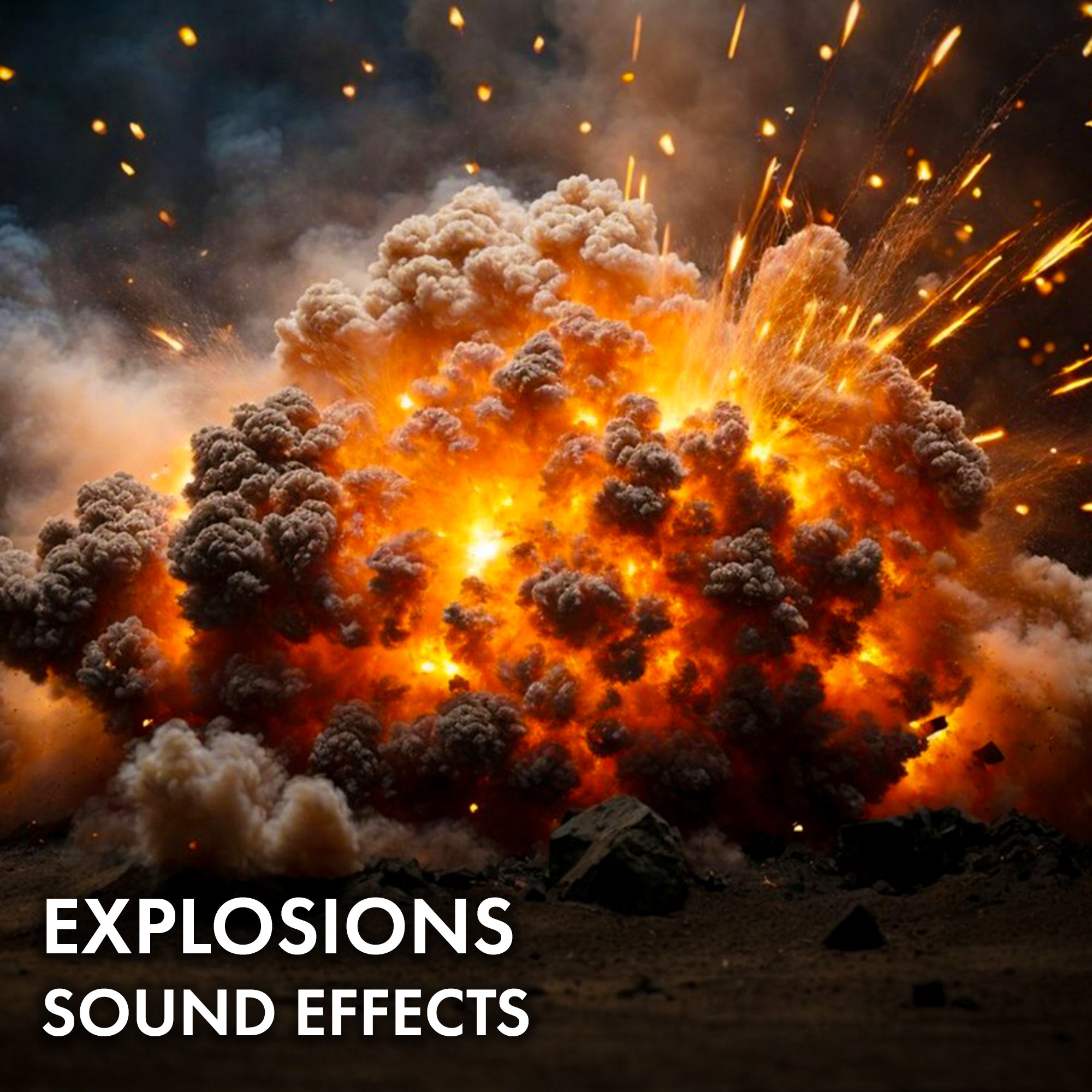
The same principle applies to all sound effects: what appears to be a single event, like an impact or an explosion, will tend to sound more interesting if it is actually composed of multiple, closely spaced events. Let’s use a giant’s footstep as an example. One reason that the sound of a huge creature footstep, like that of a Tyrannosaurus Rex, is rarely successfully done using the traditional Foley technique is that it begs for the Multiple Closely Spaced Impact (MCSI) approach.
A gargantuan creature like a T-Rex is so heavy that one of its footsteps on almost any surface is going to crunch or break or slide multiple elements of that surface. Even if there is no visual evidence of multiple events in a single T-Rex foot impact, as an audience we will tend to buy the MCSI treatment because we have an ingrained sense that extremely heavy things don’t land with a simple, single transient (except in cartoons).
The MCSI technique, which may be three to eight impacts over a period of one second or less, is very difficult for a Foley performer to do in real time, especially given that there needs to be some significant sonic variation during that very brief period. So, though a Foley artist can definitely contribute useful
elements to mega-footsteps in real time, some fairly intense editing will usually be required to give the footstep the desired scale, as will additional, non-Foley’d sound effects with MCSI characteristics.
Obviously, small pieces of grit won’t help much for a T-Rex footstep. Instead, I suggest trying the attacks in sounds like tree limb breaks, sledge hammer hits, water melon crushes, and various kinds of explosions, all typically in durations of only a few frames each, for the closely spaced impacts. Of course, you should be guided by the kind of surface your huge creature is walking on, and you’ll often want to do some quick fade outs and add a bit of reverb to unify the diverse elements to some degree.
I also encourage you to try the MCSI approach when designing explosions themselves, as well as impacts of all kinds.
Randy Thom